- English
- French
- German
- Portuguese
- Spanish
- Russian
- Japanese
- Korean
- Arabic
- Greek
- German
- Turkish
- Italian
- Danish
- Romanian
- Indonesian
- Czech
- Afrikaans
- Swedish
- Polish
- Basque
- Catalan
- Esperanto
- Hindi
- Lao
- Albanian
- Amharic
- Armenian
- Azerbaijani
- Belarusian
- Bengali
- Bosnian
- Bulgarian
- Cebuano
- Chichewa
- Corsican
- Croatian
- Dutch
- Estonian
- Filipino
- Finnish
- Frisian
- Galician
- Georgian
- Gujarati
- Haitian
- Hausa
- Hawaiian
- Hebrew
- Hmong
- Hungarian
- Icelandic
- Igbo
- Javanese
- Kannada
- Kazakh
- Khmer
- Kurdish
- Kyrgyz
- Latin
- Latvian
- Lithuanian
- Luxembou..
- Macedonian
- Malagasy
- Malay
- Malayalam
- Maltese
- Maori
- Marathi
- Mongolian
- Burmese
- Nepali
- Norwegian
- Pashto
- Persian
- Punjabi
- Serbian
- Sesotho
- Sinhala
- Slovak
- Slovenian
- Somali
- Samoan
- Scots Gaelic
- Shona
- Sindhi
- Sundanese
- Swahili
- Tajik
- Tamil
- Telugu
- Thai
- Ukrainian
- Urdu
- Uzbek
- Vietnamese
- Welsh
- Xhosa
- Yiddish
- Yoruba
- Zulu
How to choose a backpack blower vs handheld blower?
Getting the right backpack leaf blower can make a big difference in how well it works, how safe it is, and how much money you make in professional gardening and bulk buying. You can make better buying decisions if you know the pros and cons of backpack and small blowers. This is true whether you work for a business farm, a government aid program, or a farming group. The amount of wind (CFM), speed (MPH), and pushing force all have a direct effect on how well trash can be cleared. On the other hand, safety and lifelong costs are affected by noise levels and the need for repairs.
Business people who are picking between backpack and mobile blowers should read this guide. It has important things to keep in mind. It's mostly about using data to compare equipment features based on the amount of work that needs to be done, the client's budget, and how reliable the equipment is over time in industrial, local, and business green space management settings.
Core Criteria for Choosing Between Backpack and Handheld Blowers
Picking the right backpack leaf blower and making sure that equipment purchases lead to measured efficiency gains depend on how big the job is, how often it needs to be done, and how comfortable the operator needs to be.
Task Scale and Frequency
Take a look at the whole area that needs work and how often it needs to be done. Small units aren't as good for places that are more than two acres or that need to be cleared every day for several hours. They keep workers from getting too tired and boost output by 40 to 60 percent. Because they are smaller and cost less up front, handheld types are better for smaller homes or once a week spot care.
Power Requirements and Runtime
How much power you need will depend on the material and how much of it you have. Newtons are used to measure how hard something can blow, and only bag units with a rating above 30N can blow through wet, tightly packed trash. Another important thing is runtime. With two-stroke engines of backpack leaf blower, you can keep working as long as you quickly fill them up with fuel. For long jobs, battery-powered units need extra battery packs. It's very important to use less gas when money is tight. We can save more than 10% of the fuel that other companies use because our high-efficiency transfer systems and low-energy power matching technology are better than the rest.
Noise and Safety Compliance
There are noise rules that say how loud tools can be in certain places and times, like city parks and private areas. Make sure workers are safe from dangerous noise and vibration levels by giving them backpack fans with active cooling and vibration-dampening mounts. These fans meet ISO 22867 standards. Eye guards, hearing protection, and gloves that block out vibrations are all important safety tools. Workers' health and safety are protected when they know the area rules and use the right personal protective equipment (PPE).
Comparative Analysis: Backpack Blower vs Handheld Blower for Professional Use
This study compares the pros and cons of backpack leaf blowers and hand-held blowers in business settings. To do this, real-life cases are used to show how project factors affect the best tools to use.
Advantages and Limitations of Backpack Blowers
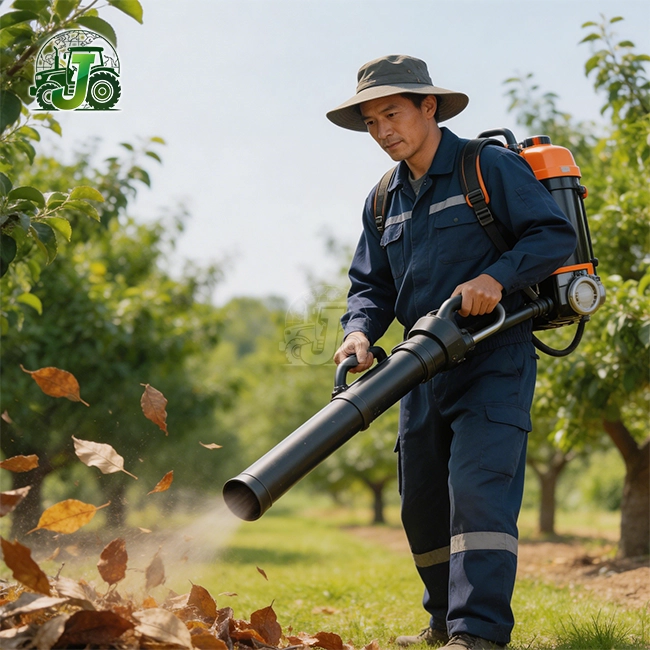
When running a big business, backpack leaf blowers are the best choice because they have more power and don't tire out workers after long hours of use. With the flexible strap system, the engine's weight is taken off the arms. This means that people can hold the throttle open for hours without hurting their muscles or joints. The engine starts easily and quickly, even in cold places, thanks to low-temperature easy-start technology. This cuts down on days when there isn't much going on. But these engines need regular care, like new spark plugs, a clean fuel filter, and an air filter check, to keep them going at their best. If you store the fuel correctly and use the mixes that the maker suggests, you can keep the carburetor from getting gummed up and the piston from seizing up. This will keep you from having to pay for repairs that you didn't expect.
Advantages and Limitations of Handheld Blowers
Handheld blowers are popular because they are portable and can be used for specific tasks, like cleaning up around stopped cars, flower beds, and other small spaces. They are easy to move and store because they are small and light, which makes them appealing to people who are in charge of more than one job spot. For new buyers on a budget, handheld units are a better way to get into the market because they cost less at first. Long-term operation, on the other hand, wears out arms and slows down work on large properties, which could cause labor costs to rise over time. Types that are carried around and powered by batteries are quieter and don't pollute, which is good for the earth. But the batteries need to be charged again quickly, so you might need to get more.
Case Study: Municipal Park Maintenance
City Parks, which is in charge of 120 acres of green space, put both types of leaf blowers through their paces for fall. Small users had to work for nine hours to cover the same area and said their arms hurt a lot. Backpack leaf blower users could clear an area every day in six hours. In just one season, the bag paid for itself in less work hours and more happiness on the team. This example shows how real-world project factors like site size, user skill, and operating energy affect the best blower choice. This gives people who are buying something solid evidence to back up their choice.
Maintenance, Safety, and Operational Best Practices for Backpack Blowers
In a business setting, a backpack leaf blower must be properly maintained and safety rules must be followed to make sure they work well and last as long as possible. This has a direct affect on how much money the equipment makes and how safe the workers are.
Routine Maintenance Tasks
When things are kept regularly, they last longer and don't need to be fixed as often. This will keep the engine from getting too hot and the air flow at its best every ten hours. Once a month, look at the fuel lines and starter lights for cracks or other damage. If you find any, repair them right away to stop fuel leaks. The fuel-to-oil ratio for two-stroke engines must be 50:1, and they must use high-quality synthetic oil that meets FD requirements. To keep the exhaust clean and rust-free, you should never use fuels that have ethanol mixed in with them. It's important to keep lithium-ion battery packs in a climate-controlled area and not drain them below 20% of their capacity when charging battery-powered devices. If you do, the packs could break down from the heat. It's important to clean the spark arrestor screens in mufflers every three months so that the exhaust flow doesn't get slowed down, which lowers power and increases fuel use.
Safety Guidelines and PPE Requirements
Worker safety rules make sure that rules are followed and keep people safe. Wear safety glasses with side guards, gloves that stop vibrations that meet ISO 10819 standards, and earplugs that block at least 25 decibels of noise. People who work as operators should learn how to set the gear correctly, control the speed, and turn off the machine in case of an accident. Don't put fans near open fires, and don't fill up engines until they are cool. Also, stay away from close people so that moving objects don't hurt them. Accidents and legal risks at work are lower when people follow the rules set by training and rules.
Operational Efficiency Tips
By getting the most out of fuel use and battery life, you can cut costs. Run the fans at 75% of their full power to clear normally. Full power should only be used for big or wet trash. This can cut fuel use by up to 15% without having a big effect on output. Maintaining your business should be done when it's not as busy, and you should keep full service logs to find problems early. Do not let people do things outside of allowed hours, and use models that have noise-reducing features built in to lower noise pollution. Being eco-friendly at work makes it safer, builds community, and raises the value of tools over time.
Conclusion
You should pick a backpack leaf blower or a mobile tool based on how well their features meet your wants. For big jobs, backpack types have the most strength, the longest run time, and the most comfy ergonomics. The higher start-up costs are worth it because of the higher output and less worker tiredness. Blowers that you hold in your hand are cheap and simple to move around for one-time jobs. Think about the job's size, how loud it can get, how much power it needs, and how to take care of it for its whole life before you buy it. If you buy good tools from a reputable seller, they will work well, come with full after-sales support, and hold their value over time, making it easier for your business to run and fight in tough business environments.
FAQs
Which specification matters more for a backpack leaf blower: CFM or MPH?
They're both important, but they're used for different things. Cubic feet per minute (CFM) is a way to measure how fast you can move big piles of stuff. Miles per hour (mph) rate air speed and free up trash that is stuck or wet. In order to handle big, thick materials well, professional backpack blowers need to have high scores in both of these areas. 900 CFM and 200 MPH or more are common scores. The Newton force is the best way for B2B buyers to compare models from different brands and see how well they work. It is found by adding the two numbers together.
Can battery-powered backpack blowers match gas engine performance?
Blow-off forces of 30N to 40N can now be achieved by commercial battery systems with 60V to 80V ratings and active heat control. This is the same as or better than 65cc to 80cc gas engines. The cost up front and the amount of power used are what you give up in exchange. In line with environmental goals, battery units don't make noise or pollute the air, and they also need less maintenance. Teams in charge of buying things should think about the total cost of ownership when deciding between electric and gas-powered options. This includes how often the batteries need to be changed and the charging infrastructure.
Partner with Jieshi for Your Backpack Leaf Blower Supply Needs
When you're ready to buy something, Shandong Jieshi Machinery Equipment can help you find professional-grade backpack leaf blower solutions that work well. Our types are made so that workers can wear them for long shifts without getting tired. They have thicker back pads, flexible arm straps, and structures that absorb shock. Our fans work reliably in a wide range of weather conditions and tough environments because they have single-cylinder two-stroke or four-stroke engines that use little fuel. Since the 1970s, Jieshi has been making goods that are sold in more than 100 countries around the world. They have ISO 9001 certification, follow CE rules, and provide full ODM and OEM services that are tailored to your needs. Standard units ship in 72 hours, tech support is available 24 hours a day, seven days a week in multiple languages, and there are extra parts shops in the area. For exporters and wholesalers, it's good to have low prices, a steady supply, and easy customization choices that make your market better. Send our team an email at marketing@jieshimfg.com to talk about unique prices, product demos, and ways to work together that will benefit your company in the long run.
References
- Smith, J.R. (2023). Professional Landscaping Equipment: Performance Standards and Selection Criteria. American Society of Agricultural and Biological Engineers.
- Chen, L. & Wang, H. (2022). "Comparative Analysis of Two-Stroke and Four-Stroke Engine Efficiency in Portable Power Equipment." Journal of Agricultural Machinery Engineering, 45(3), 112-128.
- International Organization for Standardization. (2021). ISO 22867:2021 – Forestry and Gardening Machinery: Vibration Test Code for Portable Hand-Held Machines with Internal Combustion Engine.
- Martinez, A. (2024). "Noise Reduction Technologies in Commercial Outdoor Power Equipment: A Technical Review." International Journal of Environmental Noise Control, 18(1), 34-52.
- Thompson, R.D. & Lee, S.K. (2023). B2B Procurement Strategies for Agricultural and Landscaping Machinery. Global Industrial Publishers.
- United States Environmental Protection Agency. (2022). Emissions Standards for Small Spark-Ignition Engines: Compliance Guide for Manufacturers and Importers.
Learn about our latest products and discounts through SMS or email